Trailers
The following videos are trailers for courses which I teach regularly through Rutgers University-New Brunswick’s Department of Asian Languages and Cultures. 01:574:210 Intro to Korean Culture is one of our program’s most popular offerings. It is suited to all types of students, provided they are interested in learning about Korean culture from a historical perspective. The course attracts diverse group of students with no direct ties to Korea, K-culture fans, heritage students, and those who have taken courses on China or Japan, and want to expand their knowledge about Asia.
The course is taught entirely in English. No previous knowledge of Korean language or culture is required.
01:574:220 Korean Literature in Translation is usually offered once a year in the Fall (there are still spots available for Fall 2020). We focus primarily on twentieth-century short fiction coming out of Korea. The course asks students to think about the relationship between literature, modernity, and the concept of the self.
It is taught entirely in English. No previous knowledge of Korean language or culture is required. You’ll be assigned between approximately 45-60 pages of reading per week — not too much in volume for a literature course, but the expectation is that you will be reading the material attentively. Most of it will be fiction in translation.
The trailer below:
01:574:382 Imagining Disaster (offered Spring ’21 & Spring ’23) is an interdisciplinary course for students interested in understanding modernity in Korea through an apocalyptic lens. We’ll look at a diverse array of sources, such as film, literature, comics, essays, and scholarly research.
It was initially designed as a BTAA e-school course, which means Rutgers students will have a chance to learn alongside students from other Big Ten campuses who are interested in learning more about Korea. Rutgers students take the course in person, while the other campuses participate remotely.
Like the above two courses, “Imagining Disaster” is taught entirely in English. No previous knowledge of Korean language or culture is required. However, it is designed for students who have some prior experience with or facility for analyzing cultural texts (film or literature, for example) for their formal qualities and their historical significance.
Student Work
While I continue to encourage traditional academic essays from students, I have also opened up assignment prompts to new formats. Here I include particularly successful examples, which display a range of expository, analytical, and critical abilities just as well as (if not more effectively than) the academic paper format, especially when dealing with visual sources.
Proper training in scholarly writing continues to be very important, especially for nurturing undergraduate students who may choose to enter into academic or professional fields that require rigorous writing skills and habits. However, situating the academic paper as one way among many for demonstrating intellectual abilities allows students to understand more clearly the basic challenge of rhetorical scenes — that acts of presenting, analyzing, and critiquing, occur in context-loaded situations. Learning how to deliberately respond to these situations as intellectually, socially, politically, and morally engaged human beings should be a crucial part of an undergraduate humanities education.
I also feel that perhaps even more significant for students than these pedagogic considerations is the possibility that the final product may reach an audience beyond the professor in a meaningful way. These students have given me permission to share their work in the gallery below and in some cases on my YouTube channel.
Lily Kwak situates South Korean celebrity Sulli’s untimely death within a longer history of gendered subjection in Korean history. From 01:574:210 Intro to Korean Culture at Rutgers University, Spring 2020.
Melanie Feliciano discusses the importance of LGBT politics in contemporary South Korea, touching on queer cinema, Neon Milk’s drag design, and artist-activist Heezy Yang’s critique of President Moon’s homophobic comments. From 01:574:210 Intro to Korean Culture at Rutgers University, Spring 2020.
Abbrielle Kressley discusses spatial experiences in and around N Seoul Tower in Namsan is shaped by neoliberal desires. From 01:574:392 Everyday Life in the Neoliberal City at Rutgers Ewha Study Abroad (RESA), Spring 2023.
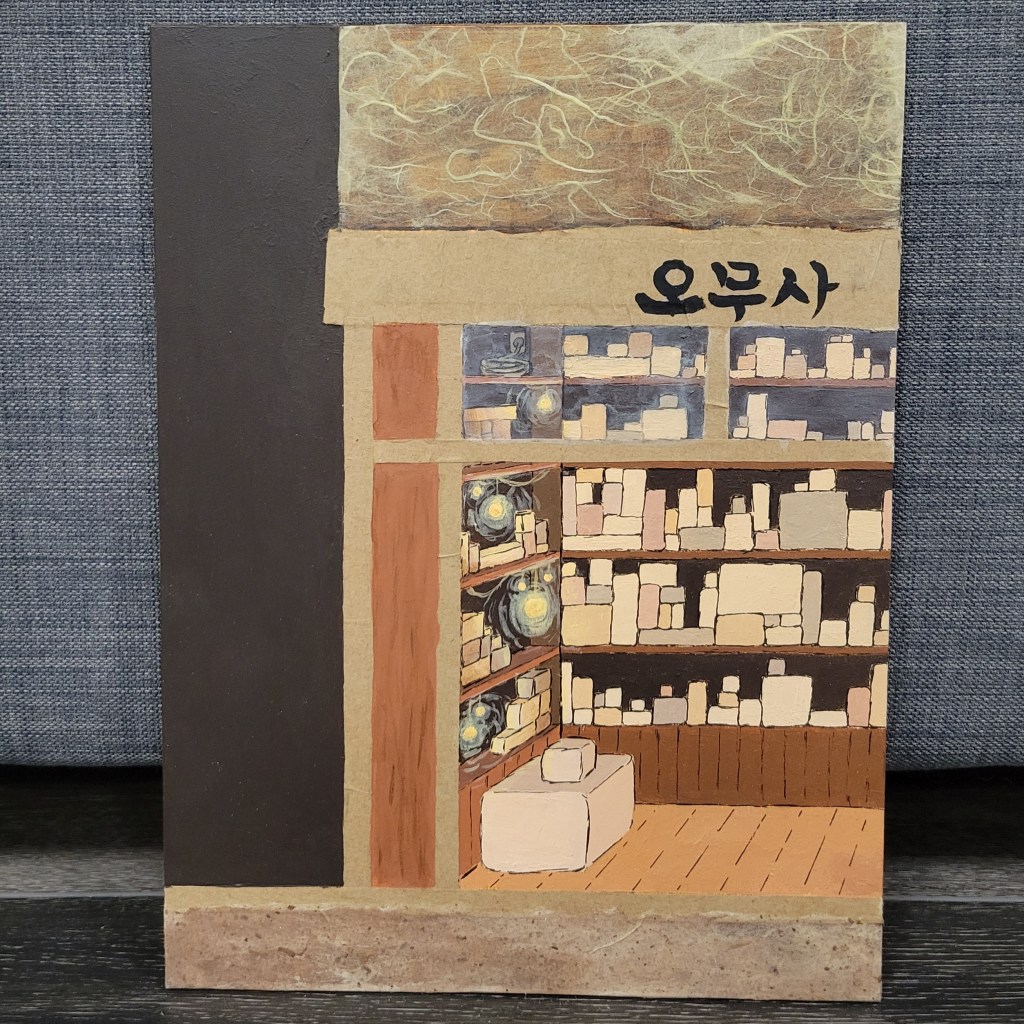
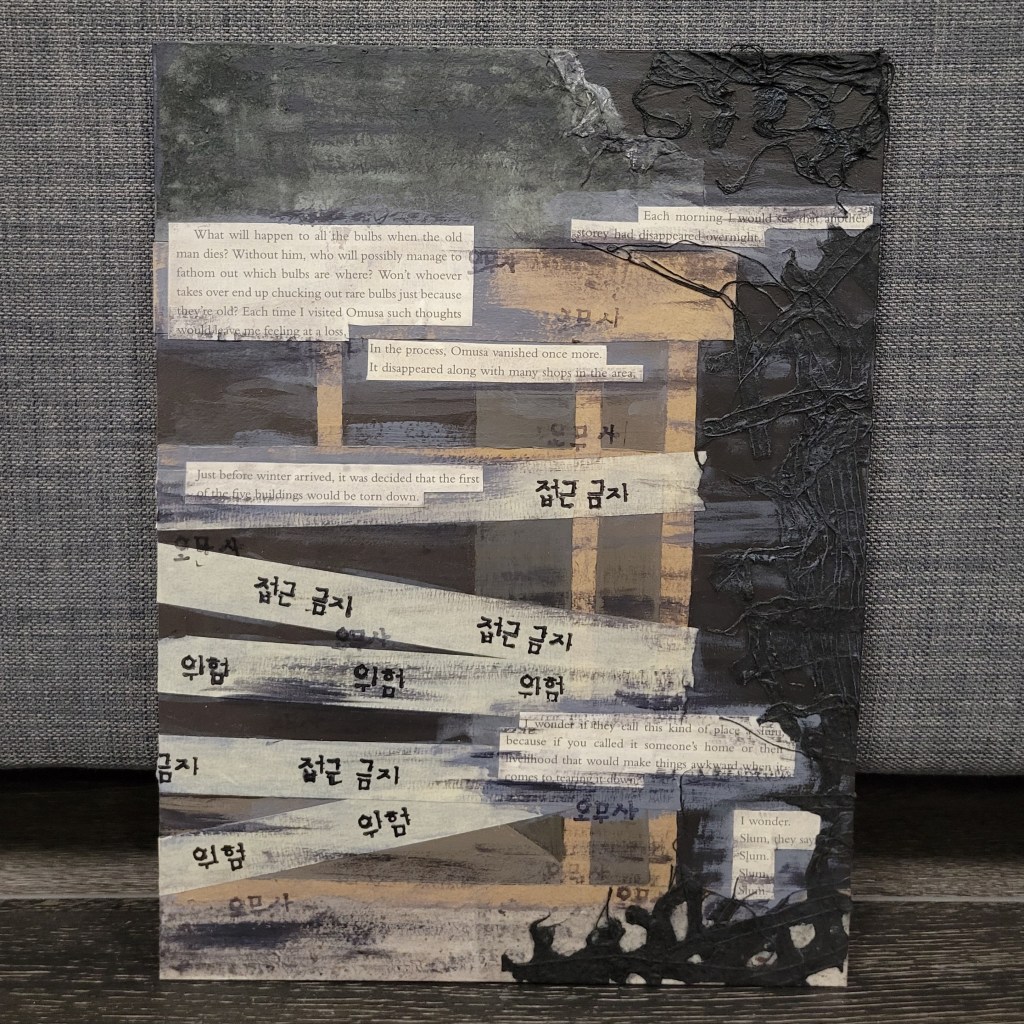
Laura Rossi produced a series of paintings based on her interpretation of Hwang Jung-eun’s novel One Hundred Shadows (2016) translated by Jung Yewon. The novel deals in part with the demolition of a building that houses small businesses, one of which is named Omusa. Laura produced two canvases “with one side being the warm and inviting image of Omusa’s and the other being the empty shop about to be demolished and turned into the new park.” From 01:574:392 Everyday Life in the Neoliberal City at Rutgers Ewha Study Abroad (RESA), Spring 2023.
Jae Won Edward Chung © Copyright 2020.
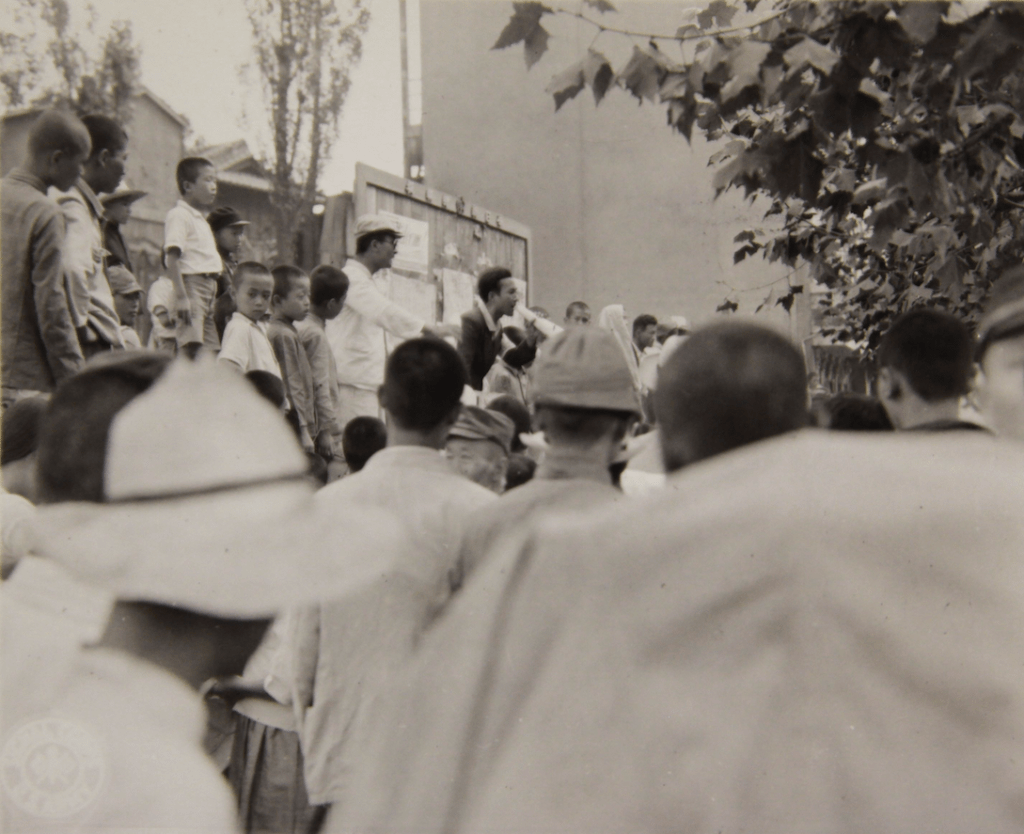
“Local Koreans demonstrating free speech…at railroad station” in Seoul. 5 Nov 1945. Photographed by S. Fusco. From NARA.
 Jae Won Edward Chung